About Alyce Wittenstein

Alyce Wittenstein is a world class attorney, blogger and filmmaker. She began working at the firm in 1985 as a managing paralegal, learning all the practices and procedures of the firm from Mr. Wittenstein and the staff. From 1995-1998, she attended CUNY Law School where she made a mark as a teaching assistant for Civil Rights leader Haywood Burns. She founded a Human Rights Delegation to Haiti and studied Constitutional Law with Supreme Court Justice Ruth Bader Ginsburg. Working at the Equal Opportunity Employment Commision (EEOC), she learned a great deal about Employment Discrimination matters. She brought her knowledge of the Personal Injury practice and her passion for Civil Rights to the firm when she was admitted to the Bar in 1999. In 2000, she became a partner and the firm name was changed to Wittenstein & Wittenstein, Esqs. PC.

EXECUTIVE–WORKER PAY ALIGNMENT ACT

SUMMARY

Executive–Worker Pay Alignment Act

The Executive–Worker Pay Alignment Act aligns increases in executive compensation with wage growth for workers at large employers. When a company increases total compensation for its highly paid executives, worker wages must increase by the same percentage during the same fiscal year. If executive compensation does not increase, the Act does not apply.

The Act does not set wages, mandate bonuses, or cap executive pay outright. It targets a specific driver of wage disparity: raising executive pay while leaving workers out. Executive compensation is treated as a connected system, preventing evasion through re-labeling, new executive hires at higher rates, equity restructuring, or compensation paid through affiliates.

PRESS RELEASE

FOR IMMEDIATE RELEASE
WASHINGTON — March 12, 2029 — Legislation introduced in Congress today would require large employers to align increases in executive compensation with wage growth for workers. Under the Executive–Worker Pay Alignment Act, companies that increase total compensation for highly paid executives must increase worker wages by the same percentage during the same fiscal year.

The bill does not set wages or cap executive pay. Instead, it applies only when executive compensation rises, preventing companies from increasing pay at the top while workers are left out. The Act treats executive compensation as a single system—covering salary, bonuses, equity, and other remuneration—and closes loopholes that allow compensation increases through reclassification or new executive hires. Supporters say the measure addresses wage disparity by ensuring executive rewards reflect shared economic outcomes rather than one-sided pay growth.

FULL BILL


EXECUTIVE–WORKER PAY ALIGNMENT ACT

A BILL

To require alignment between increases in executive compensation and worker wage growth at large employers, and for other purposes.

Be it enacted by the Senate and House of Representatives of the United States of America in Congress assembled,

SECTION 1. SHORT TITLE.

This Act may be cited as the “Executive–Worker Pay Alignment Act.”

SEC. 2. FINDINGS AND PURPOSE.

(a) Findings. Congress finds that—

  1. In recent decades, increases in executive compensation have far outpaced wage growth for workers.

  2. Compensation practices that permit executive pay increases without corresponding worker wage increases contribute to wage disparity and economic inequality.

  3. Corporations operating in the United States benefit from public infrastructure, legal protections, and economic systems supported by public investment.

  4. Aligning increases in executive compensation with worker wage growth promotes shared economic outcomes and long-term stability.

(b) Purpose.
The purpose of this Act is to align increases in executive compensation with worker wage growth, while preserving employer discretion over compensation decisions.

SEC. 3. DEFINITIONS.

  1. Covered Employer.
    Any for-profit corporation that employs more than 1,000 employees and reports annual gross revenue exceeding $500,000,000, and that operates in, sells into, or is listed on a United States financial exchange.

  2. Covered Executive.
    Any employee or officer whose total annual compensation exceeds the threshold for highly compensated employees under section 414(q) of the Internal Revenue Code.

  3. Total Executive Compensation.
    The aggregate value of all remuneration provided to a covered executive, including salary, bonuses, incentives, equity, deferred compensation, and compensation paid through affiliates or controlled subsidiaries.

  4. Workforce.
    All non-executive employees employed by a covered employer or its controlled subsidiaries.

  5. Median Worker Wage.
    The median annual wages of all non-executive employees within the workforce.

  6. Controlled Subsidiary.
    As defined in section 1563 of the Internal Revenue Code.

SEC. 4. WAGE ALIGNMENT REQUIREMENT.

(a) Triggering Event.
This section applies only in a fiscal year in which a covered employer increases total executive compensation.

(b) Worker Wage Condition.
A covered employer may not increase total executive compensation unless the median worker wage increased during the same fiscal year by the same percentage.

(c) Proportionality Requirement.
The percentage increase in executive compensation may not exceed the percentage increase in the median worker wage.

(d) Anti-Evasion Rule.
Increases include salary changes, bonuses, equity gains, compensation for newly hired executives, affiliate payments, or any restructuring that increases total remuneration.

SEC. 5. COMPLIANCE OPTIONS.

A covered employer complies by:

  1. Increasing worker wages by the same percentage as executive compensation;

  2. Holding executive compensation flat; or

  3. Redirecting excess compensation into worker wages, profit-sharing, or qualified benefit plans.

SEC. 6. DISCLOSURE AND RULEMAKING.

Covered employers shall disclose wage and compensation data annually to the Securities and Exchange Commission. The SEC may issue rules to prevent evasion and standardize reporting.

SEC. 7. ENFORCEMENT.

Non-compliant compensation is non-deductible for tax purposes, subject to civil penalties equal to 200% of excess compensation, and must be clawed back and redistributed to workers or the Treasury.

SEC. 8. EFFECTIVE DATE.

This Act applies to the first full fiscal year following enactment.

EXECUTIVE–WORKER PAY ALIGNMENT ACT

Executive Order – Enforcement and Recovery of Unlawful Self-Enrichment from Public Office (Speculative)

SUMMARY

January 20, 2029

President Orders Enforcement and Recovery of Unlawful Self-Enrichment from Public Office

Today, the President signed an Executive Order directing the identification, disclosure, and recovery of profits derived from the misuse of public office for personal enrichment. The Order affirms that federal officials have always held office as fiduciaries of the public, and that personal profits obtained through licensing, branding, naming rights, or similar arrangements tied to official authority were never lawful.

The Order instructs federal agencies to enforce existing ethics, forfeiture, and unjust enrichment laws to recover improperly obtained funds for the public treasury. It clarifies ethical obligations long recognized in law and tradition, and restores the principle that public office may not be used as a commercial enterprise.

© 2025 Alyce Wittenstein. All Rights Reserved.
Project 2029 and all associated text, structure, and policy formulations are original copyrighted works.

PRESS RELEASE

WASHINGTON — The President today signed an Executive Order directing the federal government to identify and recover profits unlawfully obtained through the misuse of public office, reaffirming that public service has always carried a fiduciary duty to the American people.

The Order makes clear that personal income derived from licensing, branding, endorsements, naming rights, or other commercial arrangements dependent on the authority, title, or exposure of public office was never permitted under federal ethics law. Such profits, where identified, are subject to recovery under existing civil forfeiture, unjust enrichment, and ethics enforcement authorities.

Under the Order:

  • Federal agencies are directed to review past and present financial arrangements of covered officials to determine whether income was derived from the exploitation of public office.

  • The Office of Government Ethics, in coordination with the Department of Justice and the Treasury, is instructed to identify funds subject to recovery under existing law.

  • Where profits are determined to have been improperly obtained, agencies are authorized to pursue disgorgement, restitution, or other lawful remedies to return those funds to the public treasury.

  • The Order explicitly states that it does not create new penalties or retroactive sanctions, but enforces ethical obligations that have always governed public office.

The Administration emphasized that public office is a position of trust, not a profit center, and that financial gains obtained through the misuse of that trust cannot be legitimized by time or repetition.

“Public office was never for sale,” the President said. “This Order enforces a principle that has always been true: money taken through the abuse of public trust belongs to the public.”

The Order takes effect immediately.

Executive Order – Enforcement and Recovery of Unlawful Self-Enrichment from Public Office (Speculative)

Queens Is the New Brooklyn

Brooklyn used to be where artists went because it was cheap, flexible, and unpoliced. That version of Brooklyn is gone. What’s left is a real-estate brand with a cultural afterimage—galleries designed around sales, neighborhoods shaped by marketing decks, and an art scene that feels increasingly managed.

Queens is where the work actually happens now.

You can see it across the borough—in Ridgewood, Sunnyside, Forest Hills, Astoria, and Long Island City—not because there’s a single “scene,” but because artists here are still allowed to work without being pushed into a look, a market, or a lane. Queens hasn’t flattened itself into a style. It doesn’t need to.

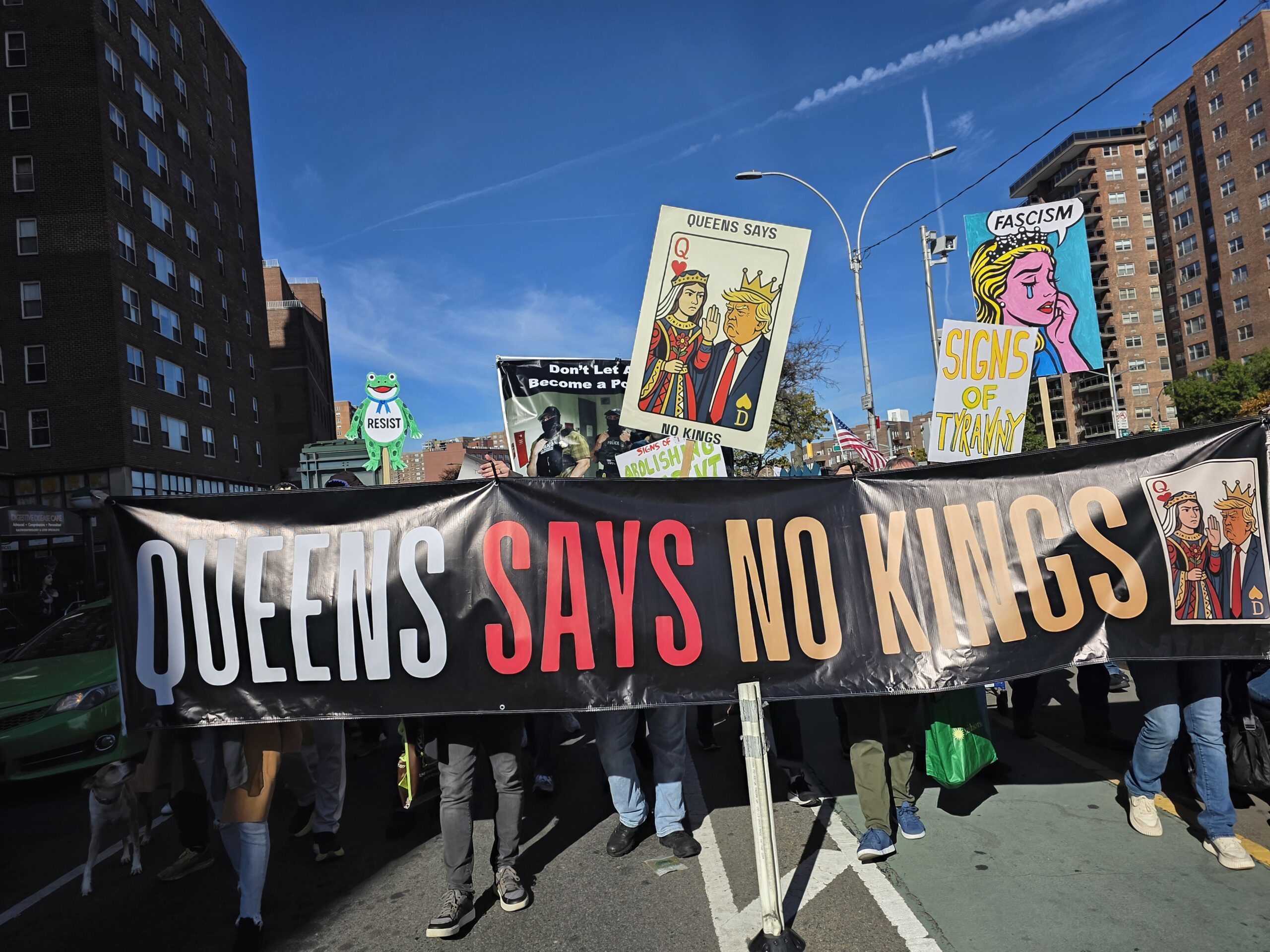
That range showed up clearly at the Queens Says No Kings march. The art wasn’t ornamental and it wasn’t outsourced. Banners, signs, and visual systems were made by people who live here and know how to communicate in public space. It held together visually without being uniform. It looked intentional, legible, and serious—on a scale that easily rivaled anything staged downtown.

The same thing is happening indoors.

In Ridgewood, artist-run spaces like Transmitter and The Hollows continue to show work that doesn’t chase trends or price points. Artists such as Cynthia Daignault, Kathy Butterly, and Lisa Oppenheim have exhibited there, anchoring Queens as a place where serious work still circulates without hype.

In Long Island City, larger platforms coexist with working studios. MoMA PS1 continues to bring international attention to experimental work, while Socrates Sculpture Park puts ambitious projects directly into public space. Artists like Sanford Biggers, Agnes Denes, and Mary Mattingly have shown work there that treats Queens not as a backdrop, but as an active context.

Sunnyside and Astoria add another layer: smaller venues, pop-up shows, shared studios, and public projects that blur the line between art, community, and daily life. This isn’t a circuit built for collectors. It’s built for people who live here.

Smaller spaces matter in this ecosystem. At Yant Art Space, the reality of Queens art is visible in a very straightforward way: different kinds of work sharing the same room without needing to match. Shows aren’t built around polish or trend. They’re built around putting work on the wall and seeing what holds up.

Artists like Alyce Wittenstein and Steve Oistringer are part of that mix. Wittenstein’s work appears both in exhibitions and in public action, including the visual language used at the Queens Says No Kings march. Oistringer designed the posters for Betaville, No Such Thing as Gravity, and The Deflowering, the three films that make up The Multiple Futures Trilogy.

This isn’t about building brands or declaring movements. It’s about proximity—artists working near each other, sharing space, showing work, and moving between galleries, streets, and other forms of cultural production without asking permission or waiting for validation.

That’s what Brooklyn used to be.

Queens Is the New Brooklyn

Resist Flower™: How Art Funds the March—and Strenghtens the Movement

Resist Flower™: How Art Funds the March—and Builds the Movement

Resist Flower™ began as an image, not a fundraising plan.

A simple visual gesture: a flower that refuses to wilt. A form that looks gentle at first glance, then insists on staying. Over time, it became something more than an artwork. It became a shared symbol—one that people recognized, carried, wore, and returned to. And now, it has become one of the ways we are materially supporting the next march.

This matters, because movements don’t run on inspiration alone. They require permits, printing, transportation, materials, accessibility accommodations, food for volunteers, sound systems, legal support, and contingency planning. None of that is glamorous, but all of it is essential. Resist Flower exists at the intersection of those realities: it turns cultural energy into practical capacity.

Where to Support the March

If you want to help fund the next march in a real, concrete way, the simplest move is to shop the Resist Flower store on Etsy:

Resist Flower™ Etsy Shop: https://www.etsy.com/shop/ResistFlower

Every purchase helps support march costs and organizing infrastructure—while also putting a symbol of resistance out in the world.

Why Art Works When Other Appeals Don’t

Traditional fundraising asks people to give because something is urgent or dire. Resist Flower asks people to participate.

When someone buys a Resist Flower sticker, tote, journal, or print, they’re not just donating—they’re taking the symbol with them. It enters their daily life: on a laptop, a notebook, a wall, a jacket. It sparks conversations. It signals values without requiring explanation. And it creates a visible, distributed presence long before a march ever begins.

This is not incidental. Movements that last understand visual language. They understand that repetition builds recognition, and recognition builds trust. Resist Flower functions as a kind of quiet infrastructure—one that spreads ahead of the event and lingers long after.

From Image to Action

Every Resist Flower item sold contributes directly to funding the next march. That funding supports:

  • Materials for signs, banners, and large-scale art builds

  • Printing costs for multilingual flyers and guides

  • Accessibility resources so more people can safely attend

  • Volunteer coordination and logistical support

  • The behind-the-scenes costs that allow a march to be organized responsibly and legally

In other words, the artwork is not adjacent to the action. It is part of the action.

This model matters because it keeps the movement independent. It allows us to raise money without relying on corporate sponsorships, political gatekeepers, or messaging constraints. The art remains ours. The message remains clear. The march remains accountable to the people who show up—not to outside interests.

A Queens-Based Aesthetic, A Collective Effort

Resist Flower is rooted in Queens: plural, dense, overlapping, and unapologetically local. It doesn’t aim for slick uniformity. It embraces texture, imperfection, and reuse. Many of the designs intentionally feel handmade, screen-printed, or stamped—because movements are built by hands, not algorithms.

As the next march approaches, Resist Flower is also becoming a shared resource. Supporters are gifting items to friends to invite them in. Volunteers are using it as a visual anchor for art builds. The symbol becomes a way to say: this is happening, and you’re part of it.

Supporting the March Without Burning Out the Movement

One of the hardest challenges in organizing is sustainability. Marches can be powerful—and exhausting. Resist Flower helps distribute the work. Instead of asking a small group to fund everything out-of-pocket, it allows hundreds of people to contribute in small, meaningful ways while receiving something tangible in return.

That exchange matters. It respects people’s limits. It turns support into a shared practice rather than an emergency ask.

What Happens Next

As we move closer to the next march, Resist Flower will continue to evolve—appearing on new materials, at art builds, and in public spaces across the borough. Every purchase helps convert cultural presence into logistical readiness.

Art doesn’t replace organizing. But it can finance it, strengthen it, and make it visible long before the streets fill.

Resist Flower™ is proof of that: a symbol that raises money, builds recognition, and reminds us that resistance doesn’t always arrive shouting. Sometimes it grows—quietly, persistently—until it’s everywhere.

Support the march here: https://www.etsy.com/shop/ResistFlower

Resist Flower™: How Art Funds the March—and Strenghtens the Movement

Art Builds Communities

Art does not arrive fully formed. It is built—collectively, physically, in shared space. Before it appears on a street or in a march, it appears in conversation, in planning sessions, in rooms where people cut, paint, argue, revise, and keep going. This process is not secondary to the work. It is the work.

Community is strengthened not only by what art represents, but by how it is made. An art build gathers people who might not otherwise meet. It gives them a common task, a shared visual language, and a reason to stay in the room together long enough for trust to form. The result is more than objects. It is continuity.

In preparation for the next No Kings march, a large-scale art build is underway—one that treats visual presence as essential, not decorative. Signs, symbols, and constructed forms are being developed with the understanding that they will be carried by many hands, seen from many distances, and read in motion. This kind of work demands clarity, durability, and collective authorship. It is designed to be used.

What happens in these builds matters beyond the march itself. People show up not as spectators but as participants. Skills are shared. Decisions are made together. The labor is visible. Art becomes a civic act—something that belongs to everyone involved, rather than something handed down fully resolved.

This is also how places become cultural centers: not through branding, but through sustained activity. Queens does not need permission to claim its place on the art map. It earns it every day through lived practice—through studios, community spaces, libraries, storefronts, and living rooms that function as sites of production. The work being made here is shaped by proximity, diversity, and immediacy. It is responsive because it has to be.

Brooklyn had its moment. Its mythology is now well documented, well marketed, and increasingly detached from daily life. Queens, by contrast, is not performing an identity. It is producing one. The art coming out of this borough is inseparable from the communities that make it—multilingual, intergenerational, and grounded in actual use rather than trend.

Preparing for a major art build is, in this sense, an act of cultural declaration. It says that the visual language of protest, care, and resistance is being authored here. That Queens is not a feeder system or a periphery, but a center—living, breathing, and in motion.

Art strengthens communities because it requires them. And when communities build together at scale, they don’t just make images. They make presence.

Art Builds Communities