


NEW YORK CITY KNEE INJURY ATTORNEY
The most common cause of knee injuries are traffic accidents and falls. An experienced New York City knee injury attorney knows that when there are multiple injuries from an accident, sometimes a knee problem is not apparent until several hours or even the day after the accident, when there is substantial swelling and pain. If there is any trauma to your knee from any kind of accident, it’s wise to immediately seek medical treatment even if the injury does not seem severe. Prompt treatment can often minimize the harm to the knee. It’s also important to consult with an experienced New York City Knee Injury Attorney to find out your legal rights.
It’s a good idea to go to the Emergency Room from the scene of the accident to rule out the most severe types of injuries. Emergency Rooms will take X-rays to see if there is a fracture in your knee as well as assessing any other injuries you might have. X-rays will only show broken bones, so “soft-tissue” injuries will require follow-up outside the Emergency Room.
These are the most common types of soft tissue knee injuries:
PCL Knee Injuries
The Posterior Cruciate Ligament (PCL) connects the femur to the tibia. It is located towards the back of the knee. It is a strong ligament, but can be torn with strong trauma such as a high-speed traffic accident, a pedestrian hit by a car or a fall from a height. Symptoms of a torn PCL include swelling, instability, difficulty walking and severe pain. A regimen of physical therapy can sometimes treat a PCL tear, but sometimes surgery is necessary.
MCL Knee Injuries
The Medial Collateral Ligament (MCL) is a ligament on the inner part of the knee which prevents over extension. This type of injury is usually caused by a direct blow to the outside of the knee. Symptoms of a torn MCL include a “popping sound” when the injury occurs, swelling, tenderness in the back of the knee and instability. MCL do not usually require surgery, but a brace may be necessary for some time due to the instability. Physical therapy is usually very helpful.
ACL Knee Injuries
The Anterior Cruciate Ligament is the most common serious injury in the knee. The ACL stabilizes the shin bone to ensure that it moves normally. There types of trauma that can cause ACL injuries including:
- Changing direction quickly
- Suddenly decreasing speed when running
- Landing a jump
- A collision
- Twisting (when falling)
Symptoms of an ACL tear include a “popping sound” at the time of injury, swelling, non weight bearing and instability. Doctors usually use an MRI and clinical correlation to diagnose a torn ACL. If the ACL is sprained and not torn, physical therapy may all that is needed. For simple torn ACL’s arthroscopic surgery is sometimes recommended. More severe tears may require a surgical ACL reconstruction.
NEW YORK CITY KNEE INJURY ATTORNEY
If you have hurt your knee in an accident, you need the best medical treatment. You also need the best Personal Injury Attorney to help you collect money for your medical bills, lost earnings, out of pocket expenses, plus compensation for your pain and suffering. Wittenstein & Wittenstein has been helping victims with knee injuries for over 60 years. Please call for a free consultation at 718-2611-8114.
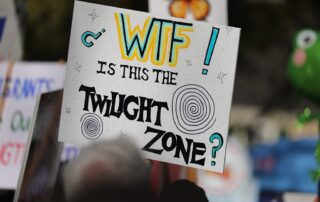
Queens, Brooklyn, and the Geography of Resistance Art
Art movements are shaped by geography — not just aesthetics. For decades, Brooklyn functioned as New York’s shorthand for experimental political art. That reputation was earned. Poster workshops, print collectives, underground presses, and radical galleries played a real role in anti-war organizing, labor movements, and later global justice actions. But movements migrate. Queens is where political art now intersects most directly with lived conditions. It is where organizers, immigrants, students, workers, and artists share space without insulation. The art is less polished, less ironic, and more accountable to consequence. That shift mirrors global patterns. In cities worldwide, the most effective protest art emerges not from cultural centers, but from pressure points — places where policy [...]
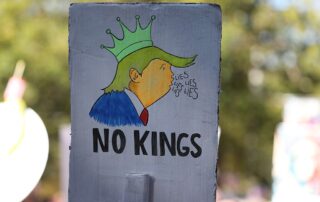
Art Movements, Protest Lineage, and Why This Work Exists
Political art has never been ornamental. At its best, it has functioned as logistics, memory, and coordination — a parallel system of communication when official systems fail or turn hostile. From the hand-printed posters of the U.S. Civil Rights era, to anti-apartheid graphics in South Africa, to the silk-screened iconography of May ’68 in Paris, visual language has repeatedly done three things movements require:signal alignment, create cohesion, and make resistance visible at scale. In the 1950s and 1960s, civil rights organizers did not treat posters, buttons, and printed materials as accessories. They were how people recognized one another. How messages traveled when mass media refused to carry them. How collective identity took shape across neighborhoods [...]

EXECUTIVE–WORKER PAY ALIGNMENT ACT
SUMMARY Executive–Worker Pay Alignment Act The Executive–Worker Pay Alignment Act aligns increases in executive compensation with wage growth for workers at large employers. When a company increases total compensation for its highly paid executives, worker wages must increase by the same percentage during the same fiscal year. If executive compensation does not increase, the Act does not apply. The Act does not set wages, mandate bonuses, or cap executive pay outright. It targets a specific driver of wage disparity: raising executive pay while leaving workers out. Executive compensation is treated as a connected system, preventing evasion through re-labeling, new executive hires at higher rates, equity restructuring, or compensation paid through affiliates. PRESS RELEASE FOR IMMEDIATE [...]

Executive Order – Enforcement and Recovery of Unlawful Self-Enrichment from Public Office (Speculative)
SUMMARY January 20, 2029 President Orders Enforcement and Recovery of Unlawful Self-Enrichment from Public Office Today, the President signed an Executive Order directing the identification, disclosure, and recovery of profits derived from the misuse of public office for personal enrichment. The Order affirms that federal officials have always held office as fiduciaries of the public, and that personal profits obtained through licensing, branding, naming rights, or similar arrangements tied to official authority were never lawful. The Order instructs federal agencies to enforce existing ethics, forfeiture, and unjust enrichment laws to recover improperly obtained funds for the public treasury. It clarifies ethical obligations long recognized in law and tradition, and restores the principle that public office [...]
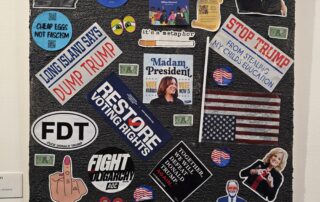
Queens Is the New Brooklyn
Brooklyn used to be where artists went because it was cheap, flexible, and unpoliced. That version of Brooklyn is gone. What’s left is a real-estate brand with a cultural afterimage—galleries designed around sales, neighborhoods shaped by marketing decks, and an art scene that feels increasingly managed. Queens is where the work actually happens now. You can see it across the borough—in Ridgewood, Sunnyside, Forest Hills, Astoria, and Long Island City—not because there’s a single “scene,” but because artists here are still allowed to work without being pushed into a look, a market, or a lane. Queens hasn’t flattened itself into a style. It doesn’t need to. That range showed up clearly at the Queens Says [...]
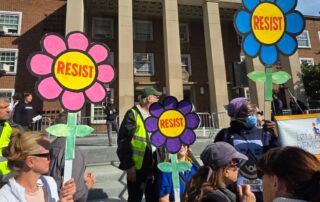
Resist Flower™: How Art Funds the March—and Strenghtens the Movement
Resist Flower™: How Art Funds the March—and Builds the Movement Resist Flower™ began as an image, not a fundraising plan. A simple visual gesture: a flower that refuses to wilt. A form that looks gentle at first glance, then insists on staying. Over time, it became something more than an artwork. It became a shared symbol—one that people recognized, carried, wore, and returned to. And now, it has become one of the ways we are materially supporting the next march. This matters, because movements don’t run on inspiration alone. They require permits, printing, transportation, materials, accessibility accommodations, food for volunteers, sound systems, legal support, and contingency planning. None of that is glamorous, but all of [...]